Moisture control combines rain exclusion, air sealing, vapor behavior and interior humidity management. Corrugated steel responds quickly to Florida sun and outdoor humidity, so a container insulation plan has to manage more than nominal R-value.
The building-science problem inside a steel container
A shipping container is thin, highly conductive and nearly all exterior surface. In direct sun, the roof and walls can become very hot. When humid air reaches steel cooled below its dew point, liquid water can form on the metal. That is why gaps, unsealed penetrations and poorly detailed framing can undermine an otherwise thick insulation layer.
Why spray foam is often considered
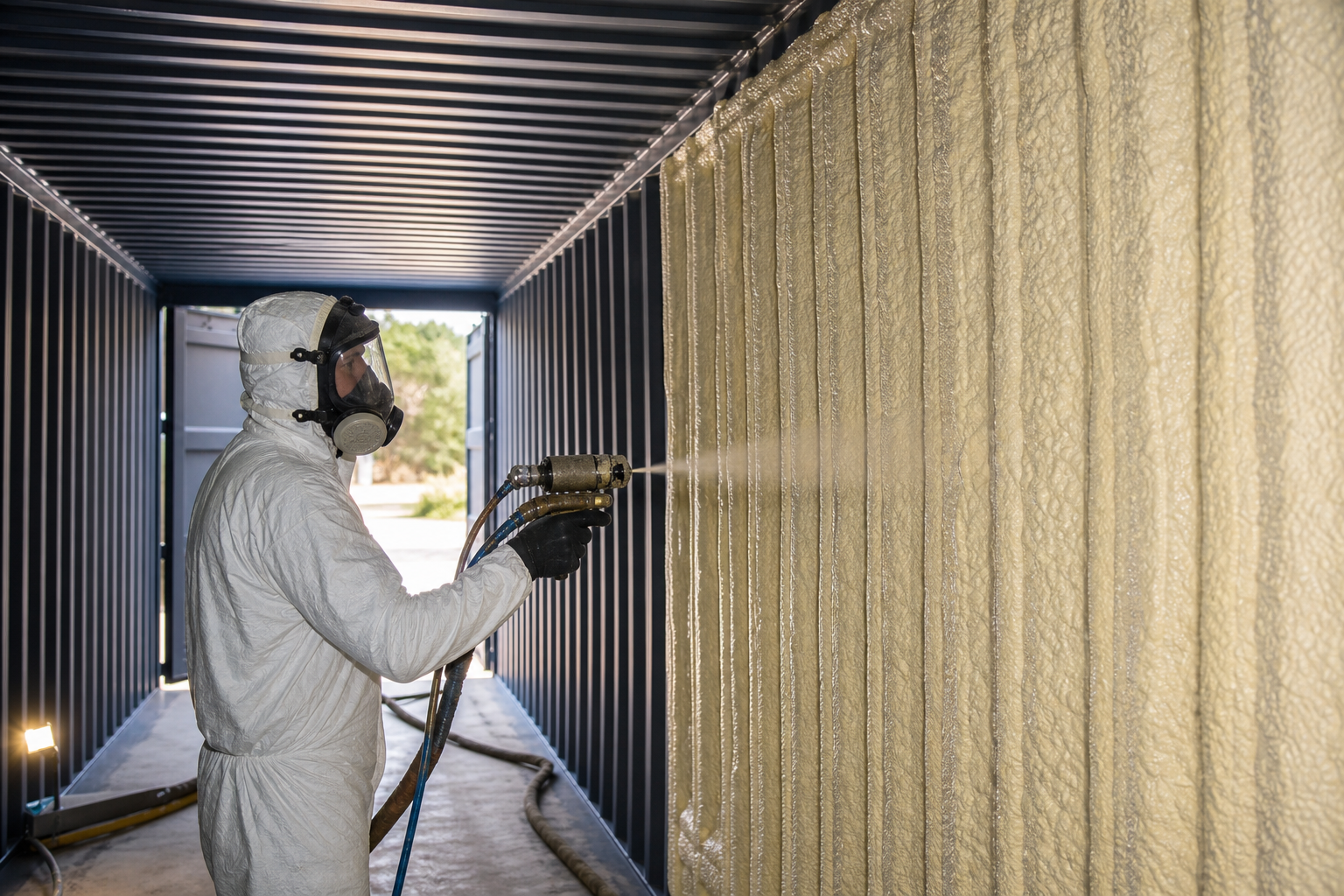
Spray foam can follow the corrugations and adhere directly to properly prepared metal, limiting air movement behind the insulation. Closed-cell foam is commonly evaluated for container work because it provides relatively high R-value per inch and stronger vapor resistance than open-cell foam. That does not make it automatic: substrate cleanliness, rust, active leaks, foam thickness, interior humidity, fire protection and finish materials all affect the final assembly.
Potential advantages
- Continuous contact with irregular corrugated surfaces
- Combined thermal and air-control layer
- Useful performance where interior dimensions are limited
- Reduced opportunity for humid air to circulate against cold steel when detailing is continuous
Planning considerations
- Closed-cell foam generally costs more than open-cell products
- Metal must be dry, clean and suitable for adhesion
- Welds, cut openings and roof penetrations must be weather-tight first
- Most occupied uses require an approved interior thermal or ignition barrier
Container use changes the recommendation
A storage container without air conditioning has different condensation dynamics than a continuously cooled office or home. Workshops add occupant moisture and may have large doors. Refrigerated or temperature-controlled operations create more demanding temperature differences. Tell us the location, dimensions, intended use, cooling plan, interior framing and finish so the scope can reflect the real operating conditions.
Do not trap an active leak
Spray foam should not be used to hide roof corrosion or leaking seams. Water entry and structural repairs belong ahead of insulation, and the metal surface must meet the product manufacturer’s preparation requirements.
Typical container insulation sequence
- Inspect the shell, roof, door seals, penetrations, coatings and corrosion.
- Confirm the intended interior use, cooling strategy and required finished dimensions.
- Complete welding, framing coordination and leak repairs before application.
- Clean and prepare metal, mask protected components and provide ventilation.
- Install foam in controlled passes to the specified thickness and inspect coverage.
- Add code-required protection and interior finishes appropriate to the use.
Keep researching your container assembly
Read closed-cell foam for containers, container condensation control and open cell versus closed cell for metal shells. For pricing, use the free estimate form and include container size, use and location.
Frequently Asked Questions
How do I request a Shipping Container Moisture Control estimate?
Use the estimate form with the property ZIP code, approximate size, project type, existing insulation and preferred contact method, or call (305) 684-3580.
Does Insulation Aces serve my area?
Insulation Aces serves Miami-Dade County, Broward County and the Florida Keys.
Can you recommend insulation from square footage alone?
Square footage helps with planning, but access, existing conditions, moisture, material, thickness and preparation also affect the recommendation and price.